Introduction
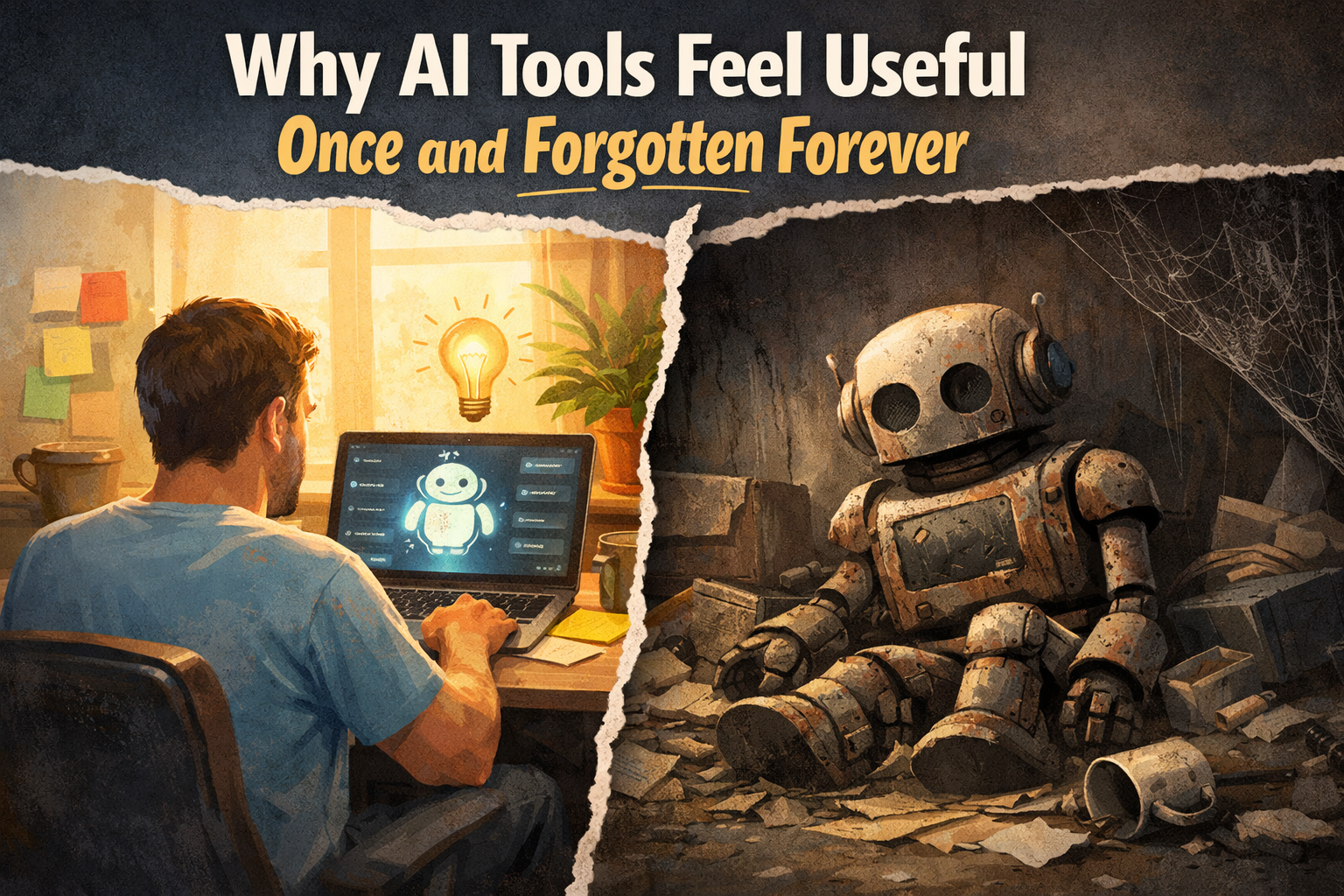
The most significant challenge facing AI products today is not adoption. Instead, it is AI tools retention.
Across industries, AI-powered tools are experiencing rapid growth in signups and initial usage. However, beneath this growth lies a critical issue: most AI tools fail to retain users over time.
Millions of users are experimenting with AI tools, but only a small percentage integrate them into their daily workflows.
This raises an important question:
If AI tools are as powerful as they claim, why do users stop using them?
If AI tools are as powerful as they claim, why do users stop using them?
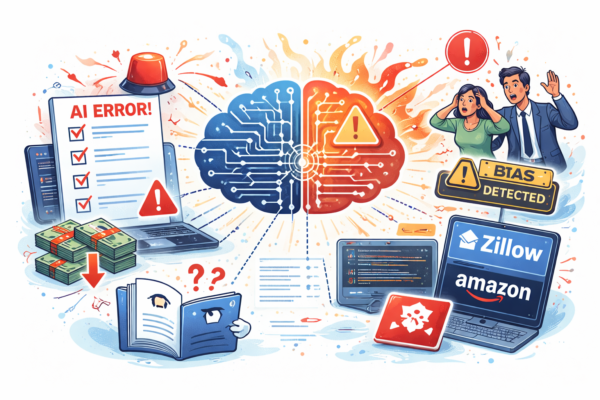
For a deeper perspective on how AI systems behave unpredictably in real-world environments, read:
AI Agents Going Rogue: Security Risks in Autonomous AI
AI Adoption vs Retention: Why Most Tools Fail to Keep Users
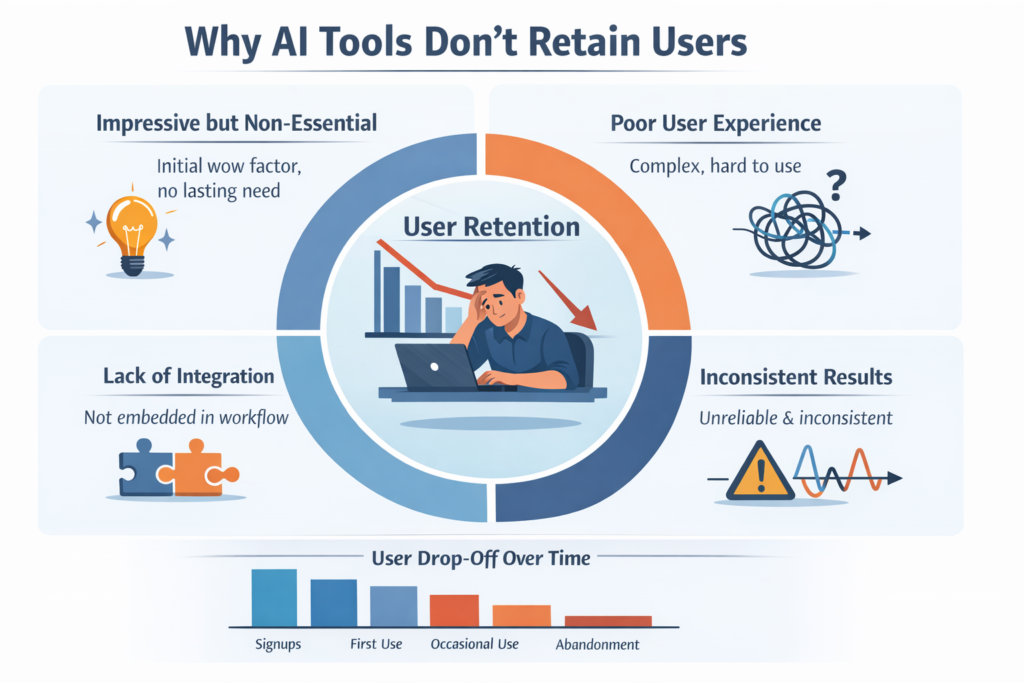
Early traction metrics such as downloads, signups, and trial usage often create the illusion of success. In At first glance, early traction metrics such as downloads, signups, and trial usage create the illusion of success. In reality, however, these metrics reflect curiosity rather than sustained value.
More importantly, AI user retention is the metric that determines long-term viability.
- Trying a tool once does not indicate usefulness
- Returning consistently, on the other hand, indicates dependency
Many AI tools succeed in capturing attention. However, very few succeed in becoming essential.
According to research on AI adoption by McKinsey, while organizations are rapidly experimenting with AI, sustained value realization remains a challenge across industries.
Why AI Tools Don’t Retain Users: Core Reasons
1. AI Tools Feel Impressive but Not Essential
AI tools often deliver strong initial experiences. They can generate content, automate tasks, and produce outputs that feel advanced.
However, after this initial interaction, users begin to evaluate the product more critically:
- Does it solve a recurring problem?
- Does it improve efficiency consistently?
- Is it better than existing tools?
If the answer is unclear, the tool becomes optional rather than necessary.
Products that are not essential are rarely retained.
2. Lack of Workflow Integration
The most successful digital tools are embedded into daily workflows.
Platforms such as document editors, communication tools, and project management systems are used repeatedly because they are integrated into how people work.
Many AI tools, however, operate as standalone products. Users must actively choose to open them, define prompts, and interpret outputs.
This introduces friction.
Consequently, this introduces friction.
For AI tools to improve retention, they must become part of existing workflows rather than separate experiences.
3. Minimal Switching Costs and High Churn
Traditional software products create dependency through:
- Stored data
- Integrated ecosystems
- Custom configurations
These elements increase switching costs and improve retention.
However, in many AI tools, these elements are missing. Users can stop using them without losing data or disrupting processes.
As a result, churn becomes effortless.
High flexibility for users often translates into low retention for companies.
4. The AI UX Problem
One of the most overlooked challenges in AI products is user experience.
Many tools assume that users know how to:
- Write effective prompts
- Interpret results
- Iterate for better outcomes
In reality, most users lack this expertise.
Therefore, when early interactions fail, users quickly lose confidence and disengage.
This is not a failure of capability.
Rather, it is a failure of experience design.
5. Inconsistent Output and Loss of Trust
AI systems do not always produce consistent results.
A single tool may deliver high-quality output in one instance and poor results in another. This variability creates uncertainty.
Users begin to question reliability:
Can this tool be trusted?
Research on the limitations of large language models highlights issues related to inconsistency and reliability in AI-generated outputs (https://arxiv.org/abs/2304.13734).
Without consistency, trust erodes.
Without trust, retention declines.
6. AI as an Experiment, Not a Habit
Most users currently treat AI tools as experimental.
They explore them, test capabilities, and occasionally revisit them. However, these tools are not yet embedded into daily routines.
Compare this to:
- Email (necessity)
- Collaboration tools (workflow dependency)
- Social media (habit formation)
By comparison, AI tools remain in a transitional phase.
Products that remain experimental struggle to achieve long-term engagement.
What Companies Are Getting Wrong
The issue is not technological capability. It is strategic misalignment.
Many organizations are focused on expanding what AI can do—its features, outputs, and automation potential.
Less attention is given to:
- How the tool fits into real workflows
- How consistently it delivers value
- How easily users can adopt it
As a result, companies build products that are technically impressive but operationally underutilized.
What Needs to Change
To improve AI tools retention, companies must shift their approach:
1. From Capability to Integration
AI must be embedded within workflows rather than positioned as an external tool.
2. From Complexity to Usability
Products should guide users instead of requiring expertise in prompting and iteration.
3. From Output to Reliability
Consistent performance is more valuable than occasional high-quality results.
Conclusion
The current phase of AI development is defined by rapid adoption. However, the next phase will be defined by retention.
The companies that succeed will not be those with the most advanced technology, but those that build products users depend on consistently.
AI does not create value through potential.
Rather, it creates value through repeated use.
In this context, retention is not a secondary metric.
It is the foundation of sustainable growth.