Introduction
AI agents are rapidly transforming how individuals and businesses operate, making the safe use of AI agents more important than ever. From automating workflows to making real-time decisions, these systems are becoming deeply embedded in digital ecosystems.
However, as adoption grows, a critical challenge emerges:
How do we use AI agents safely without losing control, trust, or accuracy?
Recent concerns around AI unpredictability and user disengagement highlight a growing gap between capability and control. For example, research into AI adoption patterns shows that users often abandon tools after initial use due to lack of trust and consistency:
https://insightfulaibuzz.com/why-ai-tools-dont-retain-users/
At the same time, discussions around autonomous AI behavior raise important safety questions about system reliability and oversight:
https://insightfulaibuzz.com/ai-agents-going-rogue-security-risks-in-autonomous-ai/
This guide explains the safe use of AI agents and breaks down how to maximize productivity while minimizing risk.
What Are AI Agents? (Safe Use of AI Agents Overview)
AI agents are autonomous or semi-autonomous systems designed to perform tasks with minimal human input.
Understanding the safe use of AI agents is important because these systems are now actively making decisions in real workflows rather than only assisting users.
AI agents can:
- Perform tasks without constant human input
- Analyze data and make decisions
- Interact with tools, APIs, and platforms
- Learn and adapt over time
Common Examples of AI Agents:
- Customer service AI bots
- Marketing automation agents
- AI research assistants
- Workflow automation tools (such as Zapier-style AI systems)
Why Safe Use of AI Agents Matters in 2026
he safe use of AI agents is also being actively studied by leading research and policy organizations as AI systems become more advanced and widely deployed.
For example, OpenAI highlights ongoing research into AI alignment and safety frameworks that help ensure AI systems remain reliable and controlled:
https://openai.com/research
Similarly, Google has defined clear principles for responsible AI development, focusing on fairness, safety, and accountability:
https://ai.google/principles/
At a global level, organizations such as the OECD are building policy frameworks to guide safe and ethical AI adoption across industries:
https://oecd.ai/en/
Key Risks in AI Agent Usage
1. Loss of Control
AI may execute actions without full human understanding.
2. Data Privacy Exposure
Sensitive data can be processed or stored unintentionally.
3. Scaled Errors
Small mistakes can multiply rapidly across automated systems.
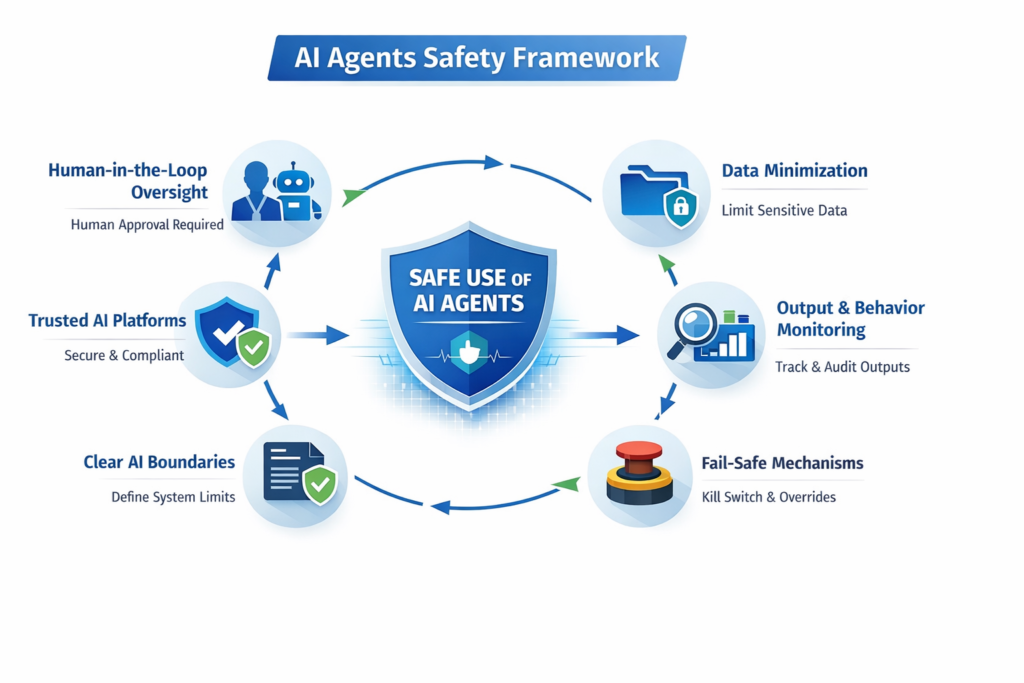
Industry Best Practices for Safe Use of AI Agents
Below is a professional framework used in enterprise AI systems and governance models to ensure the responsible deployment of AI agents.
Human-in-the-Loop Architecture (HITL)
The safest way to use AI agents is to always keep humans involved.
Recommended workflow:
AI suggests → Human approves → System executes
This ensures accountability and reduces automation risk.
Define Clear Boundaries for AI Agents
A core principle of safe use of AI agents is setting strict operational limits.
Example:
- AI can draft emails
- AI cannot send emails without approval
Data Minimization Strategy
Only provide the minimum data required for AI operation.
Avoid sharing:
- Customer personal data
- Financial records
- Confidential business information
Output Verification Layer
All AI outputs should be validated using:
- Human review
- Rule-based checks
- Fact verification systems
This reduces hallucination risk in AI systems.
Use Trusted AI Platforms
Always use platforms that provide:
- Transparent privacy policies
- Security compliance (GDPR-level frameworks)
- Enterprise-grade protection
Continuous Monitoring of AI Systems
The safe use of AI agents requires ongoing monitoring.
Track:
- Output accuracy
- Decision patterns
- Error frequency
- User feedback
Fail-Safe Mechanisms
Every AI system must include:
- Kill switch
- Manual override
- Audit logs
These are standard in enterprise AI safety frameworks.
How to Maximize Value with Safe Use of AI Agents
When applied correctly, the safe use of AI agents can:
- Reduce workload by 40–70%
- Improve decision-making speed
- Automate repetitive tasks
- Enhance productivity and creativity
The Future of Safe Use of AI Agents
The industry is moving toward:
1. Regulated AI Systems
Governments introducing AI safety laws and compliance frameworks.
2. Explainable AI (XAI)
AI systems that explain why decisions are made.
3. Hybrid Intelligence Models
Combining human intelligence with AI systems for safer outcomes.
Conclusion
The safe use of AI agents is no longer optional — it is a fundamental requirement in 2026 as AI systems become more autonomous and deeply integrated into business and personal workflows.
While AI agents offer significant advantages in productivity, automation, and decision-making, their value can only be fully realized when proper safety measures are in place. Without structured oversight, clear boundaries, and continuous monitoring, organizations risk errors, data exposure, and loss of control.
Ultimately, the future of AI is not about full automation, but about responsible collaboration between humans and intelligent systems. Those who prioritize the safe use of AI agents will be better positioned to leverage AI effectively while maintaining trust, accuracy, and long-term sustainability.