Introduction
AI Agent Workflows are transforming how modern systems interpret user intent and execute complex tasks with minimal human intervention. In simple terms, they define how an AI system moves from a user’s prompt to fully autonomous execution using structured reasoning, tools, and feedback loops. As AI becomes more integrated into daily operations, understanding AI Agent Workflows is essential for developers, marketers, and businesses building intelligent systems.
Related reading: AI Agents Going Rogue: Security Risks in Autonomous AI
Unlike traditional chat-based models, AI agents do not simply respond—they plan, act, evaluate, and improve their output dynamically. This shift is redefining automation, productivity, and digital experience design.
What Are AI Agent Workflows?
AI Agent Workflows refer to the structured sequence of steps an AI system follows to complete a task autonomously. Instead of generating a single response, the system:
- Interprets a prompt
- Breaks it into tasks
- Selects tools or APIs
- Executes actions
- Evaluates outcomes
- Refines or repeats steps
This makes AI systems closer to digital “workers” rather than static assistants.
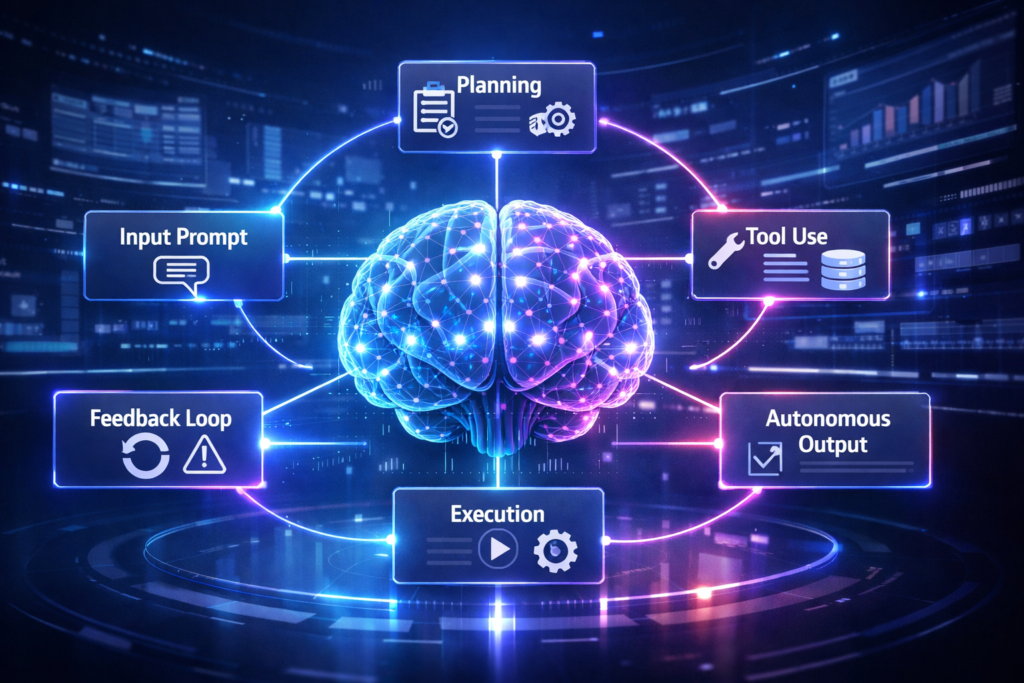
How AI Agent Workflows Function in Real Systems
1. Prompt Understanding (Intent Recognition)
The workflow begins when a user submits a request. The AI identifies:
- Intent
- Context
- Required output
At this stage, ambiguity is common, so clarification logic may be triggered.
2. Task Planning Laye
Here, the AI decomposes the prompt into structured steps.
For example:
“Create a marketing report” becomes:
- Collect data
- Analyze performance
- Generate insights
- Format report
This step is critical in defining execution success.
3. Tool Selection and Integration
Modern agents don’t rely only on language models. They connect with tools such as:
- APIs
- Databases
- Search engines
- CRMs
Read more : https://openai.com
4. Execution Phase
The AI performs tasks step-by-step using selected tools. This may include:
- Fetching data
- Writing content
- Sending commands
- Processing results
Each action is part of a controlled workflow, not a random response.
5. Feedback Loop and Self-Correction
One of the most powerful elements of AI Agent Workflows is iterative improvement.
If results are incorrect or incomplete:
- The agent revisits earlier steps
- Adjusts strategy
- Re-executes tasks
6. Autonomous Execution Stage
At this stage, the AI operates with minimal human input. It can:
- Complete multi-step tasks
- Coordinate tools
- Deliver final outputs
However, full autonomy still requires guardrails to prevent errors or misalignment.
Why AI Agent Workflows Matter in 2026
The rise of autonomous systems introduces major shifts:
- Businesses reduce manual workload
- Marketing becomes automated and data-driven
- Customer support becomes agent-powered
- Workflows replace static prompts
However, challenges remain:
- Lack of transparency
- Error propagation
- Over-automation risks
Key Challenges in AI Agent Workflows
1. Hallucinated Outputs
AI may generate incorrect intermediate steps.
2. Tool Misuse
Wrong API or incorrect execution logic.
3. Over-Autonomy
Agents may act without sufficient oversight.
4. Debugging Complexity
Hard to trace multi-step reasoning failures.
The Future of AI Agent Workflows
The future will likely move toward:
- Human-in-the-loop systems
- Transparent decision logs
- Modular agent architectures
- Safer autonomy boundaries
Instead of replacing humans, AI will increasingly collaborate with them.
Conclusion
AI Agent Workflows represent the foundation of modern autonomous AI systems, transforming simple prompts into structured, multi-step execution processes. While they unlock powerful automation capabilities, they also introduce challenges around control, transparency, and reliability.
Understanding how these workflows operate is essential for anyone building or working with AI-driven systems in 2026 and beyond. The future will not be about fully autonomous AI—but collaborative intelligence between humans and machines.